Modelling Gravitational Microlensing
Aarno Korpela describes modelling gravitational microlensing in the search of planets.
Some background
According to Einstein's general relativity light-rays bend in a gravitational field, and this effect is measurable if the ray from a background source star will pass close to some lensing body (a star, binary star, star with planets) on its way towards earth. Also galaxies bend the light from more distant galaxies. In a typical lensing event the background star will in principle have two or more images, but they can be so close to each other that they can not be seen separately. Instead, as the relative positions in the source-lens-earth system change, the total brightness of the star will show a measurable increase during the event (this is called microlensing), as the lightcurve of the star will rise to a peak-intensity and then fall back to the normal intensity in a timescale from days to months depending on the case. A single lens body will produce a symmetric lightcurve, but if it has a companion (binary star companion, or planets), the lightcurve will show a characteristic asymmetry, i.e. secondary peak or peaks as the rays are affected by the components in the lens system. In case the source-lens-observer alignment becomes perfect the star images combine into a ring-like image (the Einstein ring), with very high magnification.
Exaggerated "artist's view" of a lensing event
The way to model the event is to have parameters describing it: e.g. source star size, impact distance (how far from the lens the star apparent position is passing), lens companion mass and the location (two coordinates) relative to the central lens body. For each set of parameters you simulate the event by ray-tracing, i.e. compute the path of millions of light-rays, to derive the resulting lightcurve. Then you compare it to the observed lightcurve and then continue the search by changing the parameters again. In the (at least) five-dimensional parameter-space the search for the best fit becomes very big task, even when you can restrict the search by giving plausible boundaries to the parameters.
OGLE-71 Event
To give one example of the searches I have done, we could take the event from March 2005, where the light-curve indicates that the lens system is a star with a planet, and this planetary system is located in the next inner arm of the Milky Way, some 17,000 light-years away! All other planet detection methods can only find planets from the relatively close neighborhood of our solar system. Extending the planet detection range is important in estimating the number of planets out there, and ultimately the likelihood of life in other solar systems.
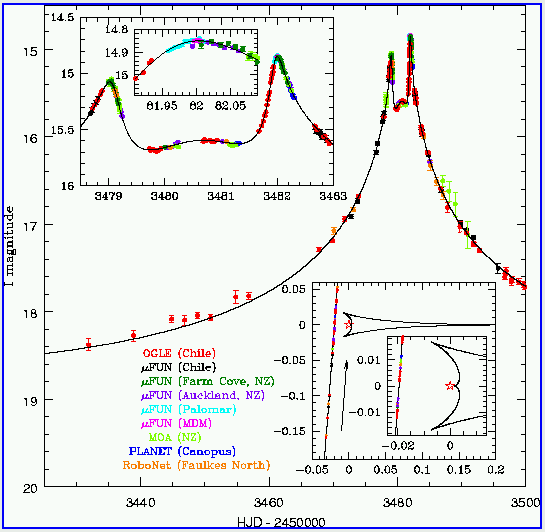
Modelled light-curve of the OGLE-71 event, together
with the observations against which the fit has been done
In a typical search of the fitting model I could arrange the jobs to try 50 different planet masses and 50 different planet distances (in a coordinate system where the lens star is at origin). This gives 2500 jobs, where each job has the task to try different source star sizes, source track distances, and source track angles relative to the lens system to find the best fit for the fixed planet mass and distance. This turned out to take about two hours (wallclock) on average for each job.
The size of the current grid, about 180 nodes, is a nice number to demonstrate the difference, as suddenly you can run a big task in one day, which otherwise would take 180 days - or half a year! In this case the task would take 5000 hours (more than half a year) on a single workstation, but with 180 nodes you can expect to get it through in about 28 hours! So you can see why we are very pleased with the availability of the grid, as we don't have to wait six months to start the following experiment! The above search is still a rough scan through the parameter space, and the most promising configurations are the starting points for searching the best fits in each neighborhood.OGLE-390 Event
An even more exciting case was detected by microlensing in July 2005, when the light curve of an otherwise normal lensing event showed a small deviation for only about 30 hours. For this event our VUW two-person team, me together with Dr Denis Sullivan, was involved in the modelling, exploring three main alternative models, of which the 'surviving' model represents the most Earth-like planet found to date outside of our own Solar system. The rocky or icy planet is about 23,000 light years away towards the Galactic centre, and is Earth-like by size, being in the likely range of 3-10 times as massive as Earth. Although the planet is not Earth-like in its conditions for life, one could say it is a really cool finding - with an estimated surface temperature less than 50 K. This discovery was one step further towards the final goal of finding a true Earth-like extrasolar planet.